
Residential Swimming Pool Leak Detection & Repair
Precision leak detection and permanent repair for residential pools across South Florida — finding leaks since 1988.
Expert Leak Detection & Repair
If we don't find your pool leak, we don't charge you!
State certified Commercial/Residential pool contractor - CPC1457754
★We are the only company with a 2-year warranty on all structural & plumbing repairs.
We have been finding pool leaks in South Florida & neighboring Islands since 1988, from basic residential pools to the multi-tiered resort pools. Whether you need urgent commercial pool leak detection for a business or property, or are considering a complete pool renovation after leak repairs, we are here to solve your mystery.
The price of water has nearly tripled since we first started, but the price for leak detection has only gone up slightly. So now more than ever, it is wisest to address this issue as soon as possible.
If We Don't Find It, You Don't Pay
We've been finding leaks in South Florida pools since 1988 — basic residential pools, complicated commercial pools, and every mystery in between. We're confident enough in that record to stand behind it: if we don't find your leak, you don't pay for the detection. And when we do find it, our structural and plumbing repairs carry a 2-year warranty. No other company in this market offers that.
Call (561) 697-3939The Bucket Test
All water evaporates so the first rule of thumb for any body of water is to determine if your water loss is actually a leak or is it just excessive evaporation. There are so many variables in water evaporation from the tension of the surface to the temperature of the water vs. the air, dew point, barometric pressure, so the evaporation rate will never be steady; it is constantly changing. To answer the question a simple BUCKET TEST is in order.
The goal here is to try to get the same/similar water surface tension and water temperature between two different bodies of water to measure against each other.

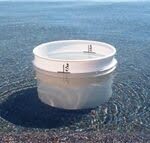
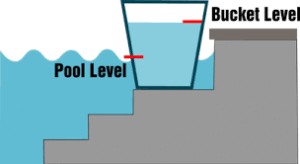
- Bring the pool water to its normal level half way in the skimmer mouth is the designed water level. *Attached spas/fountains should be full to the brink of overflow. *Commercial pools with gutters adjust the level in the pool with the pump off to be at the brink of flowing into the gutter with the gutter level full. Think of the gutter as a separate pool sitting next to the main pool and the surge tank as the 3rd pool.
- Close the pool from all living creatures, Close the auto-fill valve if equipped, keep ALL pumps and blowers off during the test to have the same/similar surface tension as the bucket.
- Pool/spa combos & commercial pools its best to isolate all bodies of water to measure them against each other, close all valves and take the pump strainer basket lid off to prevent any siphoning action if possible.
- Fill an empty bucket with pool water to about one inch from the top of the bucket. (By filling the bucket close to the top you are ensuring that air movement over the surface of the bucket will be similar to that of the pool).
- Place the bucket on the first or second step of the pool. To keep it from floating away it may be necessary to place a few bricks or rocks into the bucket but be sure to let the water in the bucket water fully absorb into the bricks & settle for 15 minutes before marking. (By placing the bucket in the pool water you are ensuring that the water temperature of each will be similar).
- Mark the water level inside the bucket with a lead pencil, tape, marker or nail polish ( I always use a pencil but inscribing back and forth is necessary).
- Mark the water level of the pool on the outside of the bucket, on the pool wall/tile, or inside the skimmer on the wall is the easiest.
- Revisit between 18 to 30 hours max, compare the two levels. If the pool water (outside mark) goes down clearly more than the inside water level, there is a leak. If the levels go down too close to tell it is just evaporating, there should be a clear difference between the two.
Signs Your Pool Is Leaking
Every pool in South Florida evaporates. The question is whether yours is losing more than evaporation can explain — and these are the symptoms homeowners call us about.
- You're adding water more than once a week, or the auto-fill never shuts off
- Wet, soft, sinking, or eroding ground around the deck or the equipment pad
- Cracks in the deck or shell, or loose and hollow-sounding tile at the waterline
- Air bubbles coming out of the return jets, or a pump that keeps losing prime
- Chemicals won't hold and the chlorine bill keeps climbing
- Algae keeps coming back despite normal maintenance
- The water bill jumped and nothing else in the house changed
Two or more of these usually means a leak, not evaporation.
Pool Leak Detection FAQs
Stop Losing Water. Call Langelier.
Every day you wait, the leak gets bigger and the ground under your deck gets softer. Call us and we'll get you on the schedule.
Call (561) 697-3939Ready to get started?
Request Service or call (561) 697-3939. Let our licensed team handle the hard work.